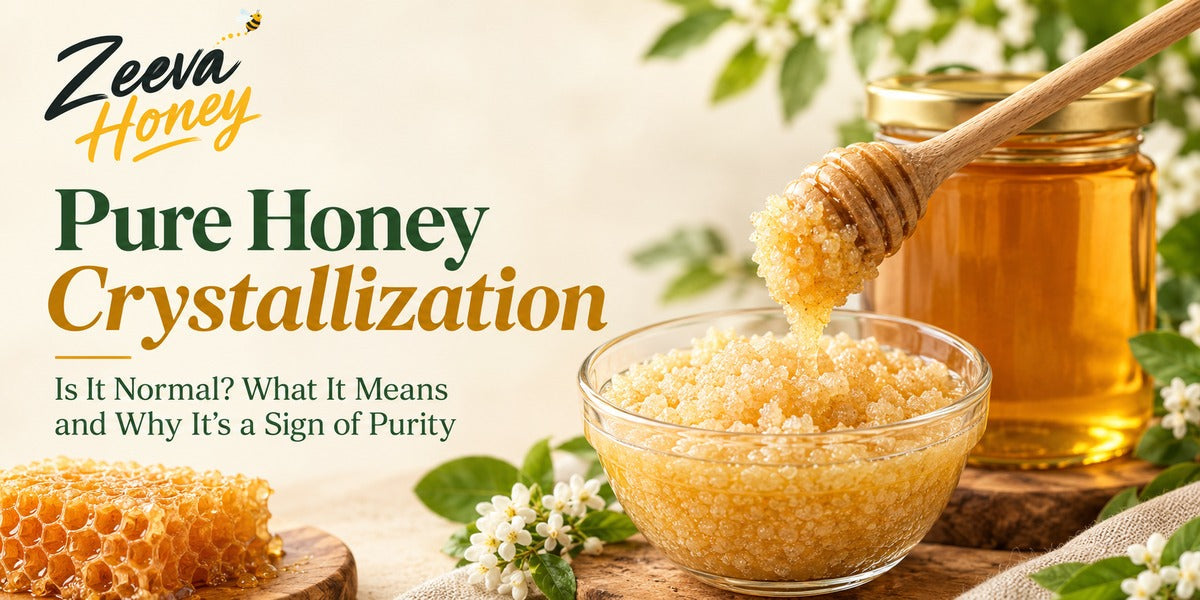
A drum of pure honey arrives at your warehouse after a long trip in cold weather. You open the lid and find a pale, thick, grainy mass instead of the golden liquid you saw in the sample. Your first thought is that something went wrong.
Most of the time, nothing did. Crystallization is one of the most common things that happens to pure honey, and it happens more often in bulk containers than in small jars. The trouble starts when buyers mistake it for spoilage or adulteration, reject a good lot, or damage it with careless heating. This guide explains why it happens and how to deal with it properly.
What Crystallization Means for Pure Honey
Crystallization is a natural process in which liquid honey slowly turns into a semi-solid mass. The texture can range from soft and creamy to hard and gritty, depending on the honey and the conditions.
Nothing has been added or lost. The honey is the same, only its physical form has changed. People also call this granulation or setting. Genuine pure honey does it sooner or later, which is why honey that never sets after many months can sometimes raise a few questions of its own.
Why Pure Honey Crystallizes: The Short Science
Honey is mostly sugar, mainly glucose and fructose, with only around 17 to 18 percent water. That's far more sugar than the water can comfortably hold, which makes honey a supersaturated solution.
Glucose is the sugar that gives up first. It dissolves less easily than fructose, so over time it forms tiny crystals. Once a few crystals appear, more attach to them, and the whole batch gradually sets.
Several things speed up the process:
-
A higher glucose share. The more glucose relative to water, the faster honey sets.
-
Particles in the honey. Pollen grains, tiny wax flakes, and even small air bubbles give crystals a place to start.
-
Temperature. Honey crystallizes fastest between about 10°C and 15°C. It sets slowly when it's very warm, and also slowly when it's very cold.
Why Bulk Pure Honey Crystallizes Differently
Bulk orders add a few conditions that small jars don't face.
Long transit in cool weather. A drum or pail may spend days in a truck, a port, or a warehouse where the temperature sits right in the range that favours crystals.
Large volume, slow cooling. In a big container, the honey cools unevenly. The outer layer near the wall sets first while the centre stays liquid.
Settling and separation. Crystals are heavier and often sink, so a drum can end up with a solid layer at the bottom and a runny layer on top. This matters more than most buyers realize, and we'll come back to it below.
Which Pure Honey Varieties Crystallize Faster?
The flower source makes a big difference.
-
Mustard honey is high in glucose and can set within a few weeks, often turning very smooth and creamy.
-
Multiflora honey usually sets at a medium pace, depending on the season and the mix of flowers.
-
Acacia and certain forest honeys contain more fructose and can stay liquid for many months.
If your order includes more than one variety, expect them to behave differently. Ask your supplier about the floral source ahead of time so you can plan storage and handling.
Is Crystallized Bulk Honey a Quality Problem?
Not by itself. Crystallization does not mean the honey is stale, fake, or unsafe.
Still, a crystallized or separated drum needs a closer look for one reason: moisture. When glucose crystals settle out, the liquid layer left on top contains relatively more water. If that water level climbs too high, the honey can start to ferment.
So the real question isn't "Has it crystallized?" It's "Has it separated, and is the liquid part still within safe moisture limits?"
How to Tell Crystallization From Fermentation
These two get confused often, and the difference matters for your stock.
Crystallized honey usually:
-
Smells sweet and floral
-
Looks pale, cloudy, and thick or grainy
-
Feels firm, creamy, or gritty
Fermented honey usually:
-
Smells sour, yeasty, or like alcohol
-
Shows foam or bubbles on the surface
-
Has a thin, watery layer on top
-
May release gas or hiss when opened
If you see signs of fermentation, set the lot aside and talk to your supplier right away. Don't blend it with healthy stock.
How Buyers Should Handle Crystallized Pure Honey in Bulk
Follow a simple routine when a crystallized lot arrives.
1. Inspect on arrival. Check the seals, the lids, and the condition of the container. Note the temperature of the storage area and take photos if anything looks off.
2. Look at the whole drum, not just the top. Open it and check for a liquid layer over a solid layer. Smell it. Check for foam.
3. Mix before sampling. If the honey has separated, a sample from the top will give a false reading. Warm the honey gently, mix it until it's uniform, and then take your sample for moisture and quality checks.
4. Liquefy gently. Use a warm room or a water-jacketed setup rather than direct heat. A temperature around 40°C is commonly used for gentle warming, and the honey should be stirred or turned so it heats evenly. Go slowly, even if it takes more than a day.
5. Avoid overheating. High or prolonged heat can dull flavour and aroma, darken the honey, and affect quality markers such as HMF and enzyme activity. Never use open flames, and don't leave honey sitting in a very hot room.
6. Transfer and pack promptly. Once the honey is liquid and uniform, fill it into clean, dry containers. Seal them well and keep them in a stable place.
Common Mistakes Buyers Make
-
Rejecting a lot because it set. Crystallization on its own is not a valid defect for pure honey.
-
Testing without mixing. A sample from a separated drum can show the wrong moisture level.
-
Heating too hot or too fast. It melts the honey quickly but can harm its quality.
-
Using the fridge. Cold storage speeds up crystallization rather than preventing it.
Storage and Transport Tips to Slow Crystallization
You can't stop crystallization, but you can slow it.
-
Store pure honey at a steady room temperature, usually somewhere around 20°C to 25°C.
-
Avoid storing near the 10°C to 15°C range for long periods.
-
Keep containers tightly sealed and away from moisture, direct sun, and strong odours.
-
Plan deliveries so honey doesn't sit in cold transit longer than necessary.
-
Use clean, dry food-grade containers and tools.
What to Agree With Your Supplier Before You Order
A few clear points in advance prevent most disputes.
-
In what form will the honey be delivered, liquid or crystallized?
-
Which floral source is it, and how fast does it usually set?
-
What moisture level does the batch carry, and can you see the test report?
-
What should the packaging and seals look like?
-
How will crystallization be treated if it happens in transit? Many buyers write into the agreement that crystallization alone is not grounds for rejection, while moisture, smell, and fermentation signs are.
Plan for Crystallization Before Your Next Pure Honey Order
Crystallization isn't a defect to fear. It's pure honey behaving the way it naturally does, and in bulk it just happens on a larger scale. Buyers who understand the cause, check for separation and moisture, and warm the honey gently end up with good stock and fewer disputes.
Planning a bulk order? Get in touch with Zeeva Honey and talk through your requirements before you buy.
Frequently Asked Questions
1. Does crystallized pure honey mean it's fake?
No. Crystallization is natural and happens in genuine honey. It isn't proof of purity either, because some pure honeys stay liquid for a long time. Check the supplier, the test reports, and the batch details too.
2. Why does bulk honey crystallize faster than jar honey?
Large containers cool unevenly, and bulk shipments often sit in cool temperatures for days. Both conditions favour crystal growth, and settling can create solid and liquid layers in the same drum.
3. How do I liquefy crystallized pure honey safely?
Warm it gently, with a temperature around 40°C commonly used, and stir or turn it so it heats evenly. Avoid direct flames and long exposure to high heat, which can damage flavour and quality markers.
4. Can crystallized honey ferment?
Crystallized honey itself is fine, but separation can leave the liquid layer with extra moisture, and that's where fermentation can start. Mix and test the honey, and look for sour smell, foam, or bubbles.
5. Can I stop pure honey from crystallizing?
Not completely. You can slow it by storing it at a stable room temperature, keeping it away from the fridge, and sealing it well. Sooner or later most pure honey will set, and that's normal.